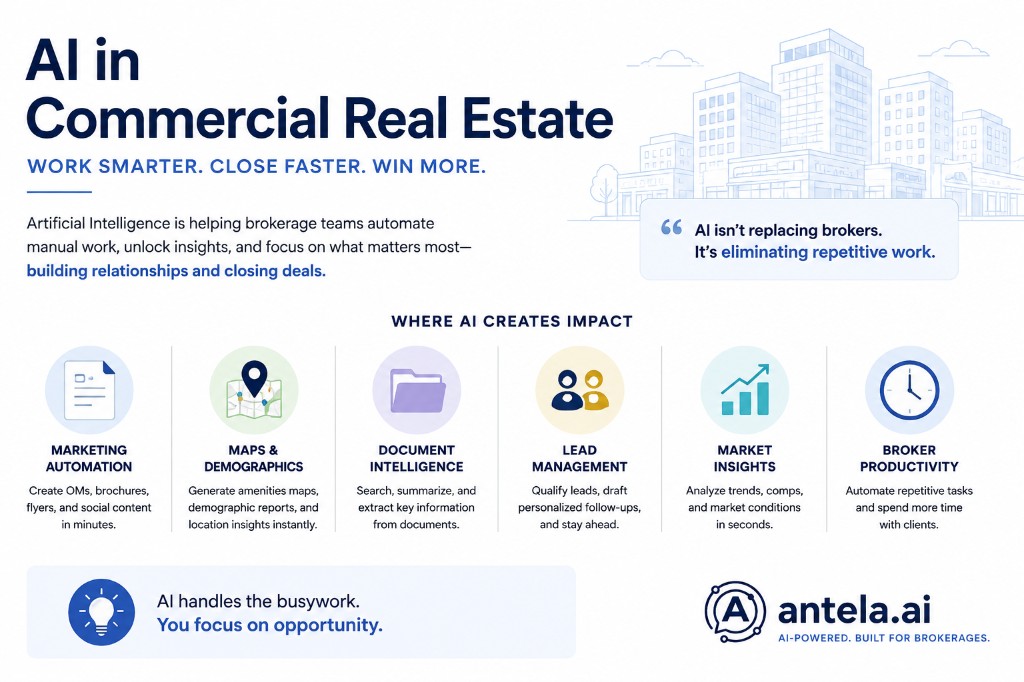
Commercial real estate has always been a relationship-driven industry. Success depends on local market knowledge, trusted advisors, and years of experience.
But while the industry has embraced digital listing platforms, many day-to-day brokerage operations are still surprisingly manual. Marketing materials are created one document at a time, property information is copied across multiple systems, and brokers spend hours every week on administrative work instead of serving clients.
Artificial Intelligence is beginning to change that.
Rather than replacing brokers, AI is helping commercial real estate professionals work faster, automate repetitive tasks, and spend more time building relationships and closing transactions.
#Artificial Intelligence refers to software that can understand information, generate content, answer questions, and automate workflows that traditionally required human effort.
In commercial real estate, AI is moving beyond simple chatbots. Modern AI platforms can understand property information, generate marketing assets, organize documents, summarize leases, analyze locations, and assist brokers throughout the entire listing lifecycle.
The goal isn't to replace expertise—it's to eliminate repetitive work.
Where AI Is Already Making an Impact
Many commercial real estate teams are already using AI in practical ways.
Marketing Automation
AI can generate:
- Offering Memorandums
- Property brochures
- Flyers
- Social media posts
- Email campaigns
- Property descriptions
- Investment highlights
What previously took hours or days can often be completed in minutes.
Document Intelligence
Commercial transactions involve thousands of pages of documents.
AI can help teams:
- Search leases instantly
- Extract key terms
- Summarize contracts
- Organize due diligence documents
- Answer questions about property files
Instead of searching through folders manually, brokers can simply ask questions.
Property Research
AI can assist with:
- Market research
- Demographic summaries
- Nearby amenities
- Comparable properties
- Investment analysis
- Location insights
Rather than replacing research, AI dramatically reduces the time required to gather information.
Lead Follow-up
Many opportunities are lost because follow-up happens too slowly or inconsistently.
AI can:
- Draft personalized emails
- Recommend next actions
- Track conversations
- Prepare meeting summaries
- Suggest follow-up timelines
This helps brokers stay engaged with prospects without increasing administrative work.
Why AI Matters Now
Commercial real estate has experienced increasing pressure over the last several years.
Brokerages are expected to:
- Do more with leaner teams
- Launch listings faster
- Maintain consistent branding
- Respond to clients more quickly
- Produce higher-quality marketing materials
- Stand out in a competitive market
AI helps address each of these challenges by increasing productivity without requiring larger teams.
What AI Cannot Replace
Despite rapid advances, AI cannot replace the skills that make great brokers successful.
Clients still rely on professionals for:
- Negotiation
- Relationship building
- Market expertise
- Strategic advice
- Local knowledge
- Trust
Buying, selling, and leasing commercial property remains a people business.
AI simply gives those professionals better tools.
The Future: AI as Your Brokerage Operating System
Today, many brokerages use separate tools for CRM, marketing, document management, email campaigns, mapping, presentations, and reporting.
The next generation of AI is bringing these workflows together.
Instead of jumping between multiple applications, brokers will increasingly work with intelligent systems that understand each property, remember previous work, automate repetitive tasks, and continuously learn how each brokerage operates.
The result is not just faster marketing—it is a more connected and efficient brokerage.
Conclusion
Artificial Intelligence is no longer a future trend in commercial real estate—it is becoming a practical tool for everyday operations.
The brokerages that adopt AI thoughtfully will be able to launch listings faster, reduce administrative work, improve consistency, and give their teams more time to focus on what matters most: serving clients and winning business.
As the industry continues to evolve, the question is no longer whether AI will change commercial real estate, but how quickly firms will adapt to take advantage of it.
Continue exploring
For a practical look at OM automation, read how to create a commercial real estate Offering Memorandum in under 5 minutes. To go deeper on AI-native operating models, see the future of AI in commercial real estate and how generative AI reduces friction in CRE marketing. Explore the full Insights archive or book a demo to see Antela.ai in action.
Keywords: Commercial Real Estate, AI for CRE, PropTech, CRE Marketing Automation, Brokerage Technology, Real Estate AI, Listing Automation, Document Intelligence
Ready to see this on one of your listings?
Continue to Antela's Antela platform — or try the workflow with one listing and book a demo when you're ready.
Frequently asked questions
Where can I learn more?
Explore Antela platform at /.