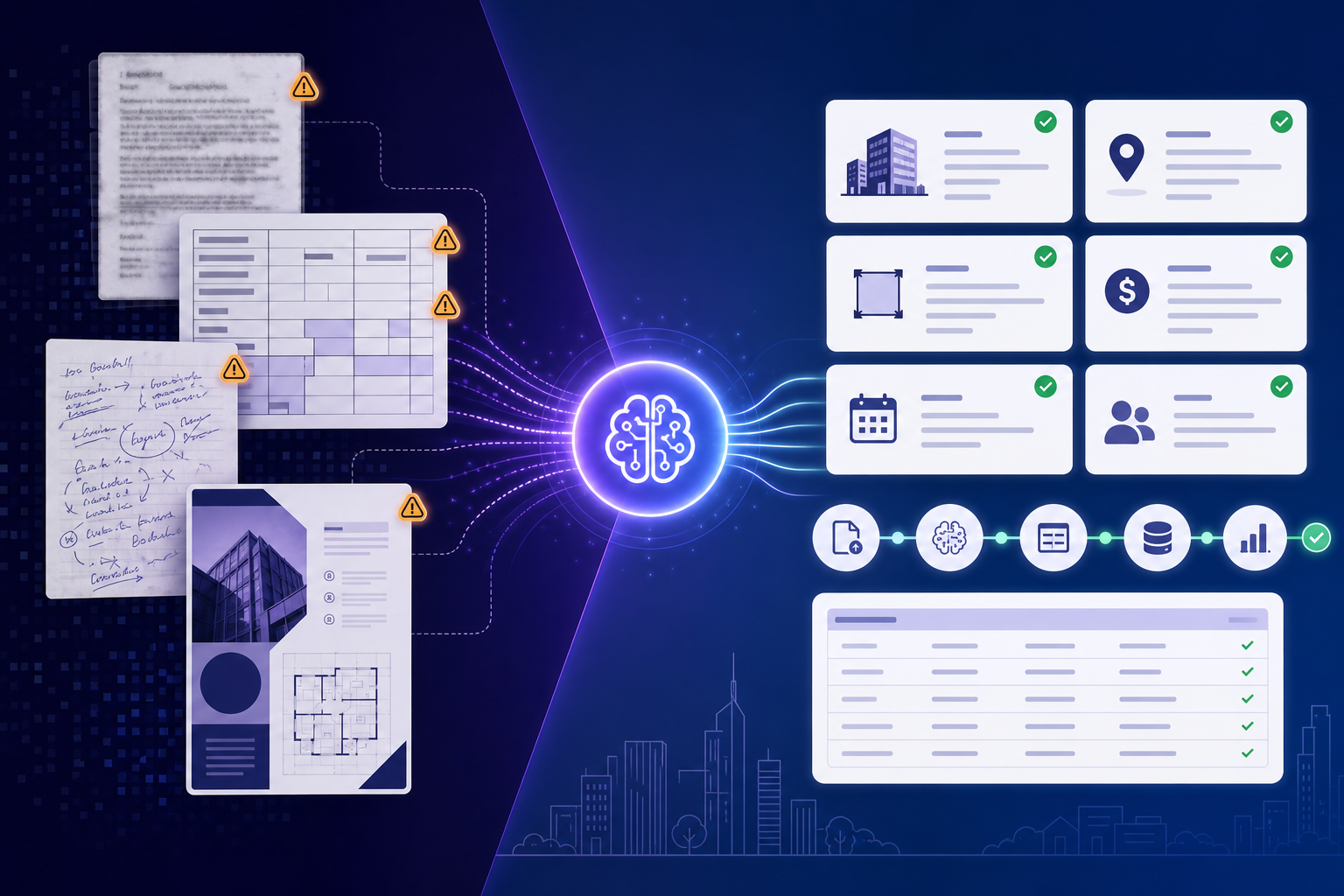
AI-powered extraction can dramatically improve Commercial Real Estate workflows.
However, CRE documents often contain operational complexity that creates extraction challenges.
Understanding these challenges helps organizations build more reliable and scalable workflows.
#Low-resolution scans remain one of the most common issues in document processing.
Problems include:
- blurry text
- faded pages
- tilted scans
- compressed PDFs
- missing page sections
Recommended Solution
Whenever possible:
- upload original source documents
- avoid screenshots
- use high-resolution scans
- avoid repeated file compression
2. Inconsistent OM Structures
Offering Memorandums vary significantly between brokerages.
Different:
- layouts
- terminology
- table structures
- section ordering
can create extraction inconsistencies.
Recommended Solution
AI workflows should combine:
- layout intelligence
- contextual understanding
- human review
- confidence scoring
instead of relying only on fixed templates.
3. Complex Financial Tables
Rent rolls and operating statements often contain:
- merged cells
- inconsistent formatting
- embedded notes
- multi-page tables
which may reduce extraction reliability.
Recommended Solution
Structured spreadsheets generally improve extraction quality compared to image-based financials.
4. Embedded Images and Graphics
Some CRE documents prioritize design-heavy marketing layouts over structured readability.
Text embedded inside graphics or images can be harder to process accurately.
Recommended Solution
Maintain accessible text layers whenever possible instead of flattening entire documents into image-only layouts.
5. Handwritten Notes and Markups
Annotations can introduce ambiguity.
This is especially common during:
- underwriting reviews
- revisions
- compliance feedback
- negotiation workflows
Recommended Solution
Use digital comments or separate review workflows whenever possible.
6. Missing or Incomplete Data
Some documents simply lack required operational information.
For example:
- missing parking counts
- incomplete tenant data
- absent financial metrics
Recommended Solution
AI workflows should identify missing information and route workflows appropriately for review.
7. Over-Reliance on Full Automation
One of the biggest operational risks is assuming AI should operate without human oversight.
The future of CRE AI is not fully autonomous workflows.
It is intelligent collaboration between:
- AI systems
- operational teams
- compliance reviewers
- brokerage processes
Building Better AI Workflows
The most effective CRE AI systems combine:
- document intelligence
- confidence scoring
- workflow orchestration
- human review
- continuous learning
This creates operational systems that improve over time.
The Future of CRE Execution
AI extraction is not just about reading documents faster.
It is about transforming operational workflows:
- reducing repetitive work
- improving consistency
- accelerating execution
- enabling smarter collaboration between humans and AI
The future of CRE AI will belong to workflows that continuously learn, adapt, and improve through execution.
Ready to see this on one of your listings?
Continue to Antela's Antela platform — or try the workflow with one listing and book a demo when you're ready.
Frequently asked questions
Where can I learn more?
Explore Antela platform at /.