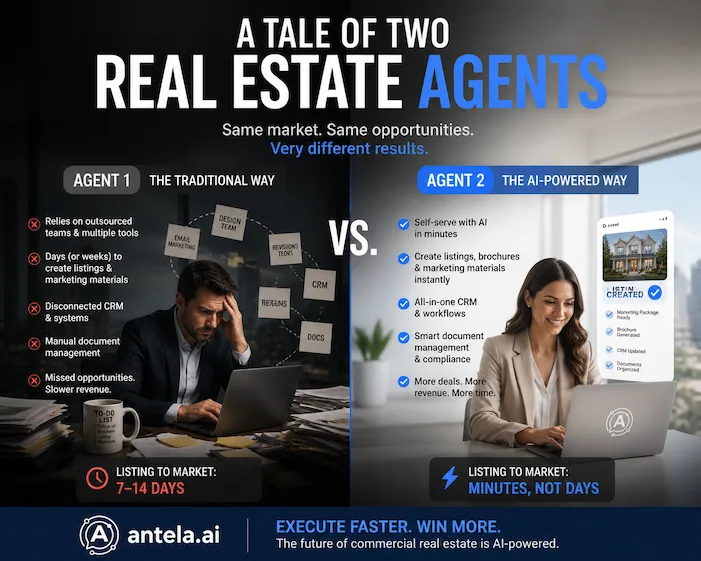
The uncomfortable truth: In commercial real estate, the gap between top producers and everyone else is rarely “who knows the market.” It’s who can move—from draft listing to live marketing—without losing a week to coordination.
We keep hearing the same story from brokers and teams. It’s less a debate about AI in commercial real estate and more a split in how work actually gets done. Two agents. Same ambition. Radically different throughput.
#Cap rates, debt costs, and tenant expectations aren’t waiting on your creative queue.
Teams are being asked to do more with leaner ops: tighter timelines, more listings, more touchpoints—often with the same headcount. Meanwhile, adoption of AI-powered real estate tools is shifting from “interesting pilot” to “how we stay responsive.”
The winners aren’t the ones who add another disconnected app. They’re the ones who remove friction between asset narrative, documents, CRM, and outreach—what a serious CRE AI platform is built to unify.
That’s the market shift: real estate workflow automation is becoming baseline infrastructure, not a novelty.
The Divide: Traditional vs. AI-Powered Workflows
On one side: how the industry has run for years.
- In-house marketing or a rotating cast of freelancers
- External designers and vendors for every revision cycle
- CRM, documents, and marketing living in separate systems
Every step needs a meeting, a ticket, or a “quick favor.” CRE marketing automation isn’t missing from the budget—it’s missing from a single executable path.
What that feels like: delays, context loss, and momentum dying in inboxes.
On the other side: operators who treat execution as a product, not a pile of tools.
They’re not waiting for “the workflow to happen.” They run it—end to end—in one connected motion.
Meet Mark and Sarah
Mark — the traditional agent
- Multiple teams and tools, each with its own SLA
- Constant back-and-forth on copy, layout, and brand guardrails
- CRM, documents, and campaigns never quite in sync
- 7–14 days (often more) from “we’re going live” to actually going live
- A calendar full of managing work instead of advancing deals
Sarah — the AI-powered agent
- Uploads a draft, OM, or even a solid photo set—the system meets her where the work starts
- AI-assisted drafts for listings, one-pagers, and outbound—fast enough to iterate with the client, not around them
- CRM, documents, and outreach tied into real estate workflow automation so nothing falls between tools
- Minutes, not days, from raw inputs to a credible go-to-market package
Same hustle. Different constraint surface.
The Real Difference: Throughput (Not “Busy”)
This isn’t vanity productivity. It’s how much business you can actually move when responsiveness is the product.
Mark (traditional): fragmented tools and a human relay race; serial, calendar-bound revisions; roughly 5–7 listings per month.
Sarah (AI-powered): a connected flow on a CRE AI platform; tight, same-day iteration loops; roughly 15–20 listings per month.
Same market. Same intent. Different execution ceiling.
The Hidden Cost Nobody Puts on the P&L
Most teams budget for the obvious line items:
- Media and sponsorships
- Outsourced design
- Another SaaS seat
The line item they don’t model is delay.
Every extra day:
- Slows deal velocity
- Weakens responsiveness when tenants and capital are comparing options in real time
- Increases the odds someone else gets to “compelling narrative + clean package” first
In CRE, speed isn’t a nice-to-have efficiency metric. It’s revenue protection.
What This Means for Brokerages
For managing partners and ops leads: the leverage isn’t “more AI demos.” It’s fewer seams.
- Brand consistency at scale stops being a bottleneck when templates, voice, and approvals live next to generation—not in a separate drive.
- Producer enablement becomes measurable: time-to-package, touches per listing, rework rates.
- Recruiting and retention tilt toward teams that don’t burn talent on admin relay.
A brokerage that treats AI in commercial real estate as workflow design—not a chatbot sidecar—will outrun one that buys five tools and still runs everything through email.
From Effort to Execution
Mark and Sarah start in the same place: a listing, a client, a number to defend.
They diverge when one is constrained by process and the other is powered by execution.
Effort is table stakes. Execution is the edge.
The Bottom Line
The next chapter of CRE isn’t “work harder” or “stack more software.”
It’s:
- Eliminating friction between narrative, collateral, and follow-up
- Compressing timelines so speed matches market reality
- Increasing throughput without multiplying headcount
The teams that win will be the ones that launch faster, respond cleaner, and close more—because the work flows.
See It in Action
If you want to see how a listing can become a full, on-brand marketing motion in minutes—not weeks—explore antela.ai.
If you’re sizing this for a team or rollout, we’re happy to walk through a concrete workflow—no slide deck theater, just the path from asset to outbound.
Antela helps commercial real estate teams turn execution into a system: one connected flow for listings, documents, CRM, and outreach—so CRE marketing automation is something you run, not something you chase.
Ready to see this on one of your listings?
Continue to Antela's Antela platform — or try the workflow with one listing and book a demo when you're ready.
Frequently asked questions
Where can I learn more?
Explore Antela platform at /.