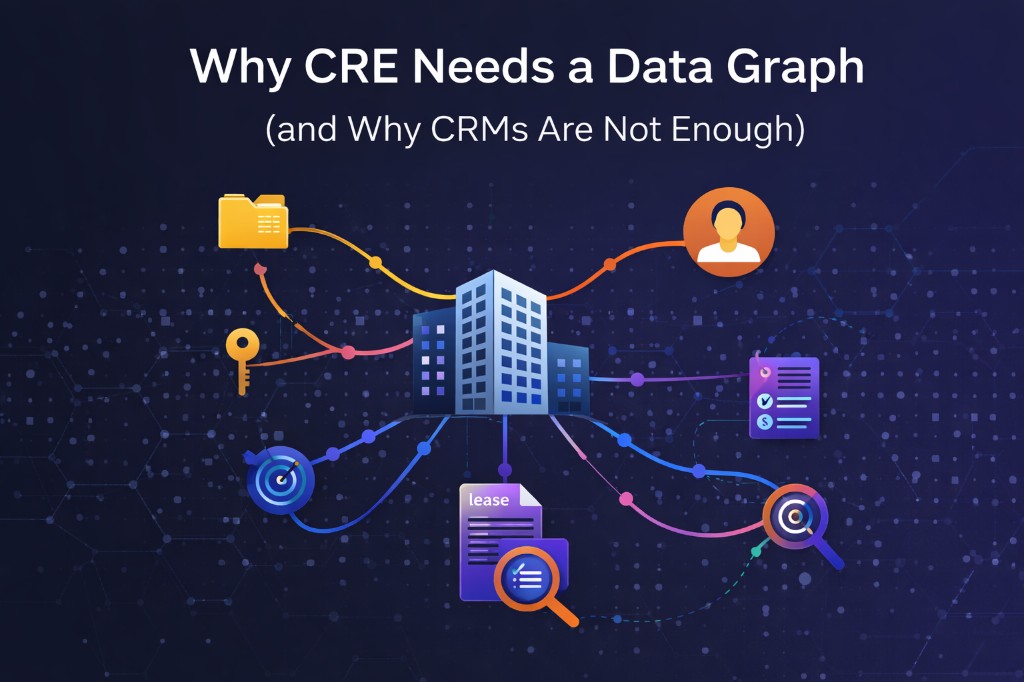
Commercial real estate (CRE) has no shortage of software.
CRMs, marketing tools, listing platforms, document systems - the stack keeps growing.
And yet, brokers still spend weeks stitching together information before a deal even moves forward.
Because the problem is not a lack of tools.
It is a lack of connected intelligence.
The Real Problem: Fragmented Data, Fragmented Execution
In today's CRE workflow, data lives everywhere:
- Property data in listing platforms
- Contacts in CRM systems
- Marketing assets in design tools
- Deal documents in shared drives
- Communication across email and messaging
Each system captures a piece of the story, but none understand the full picture.
Why CRMs Fall Short in CRE
CRMs were built to manage contacts and pipelines.
But CRE is about relationships across:
- properties
- deals
- documents
- workflows
CRMs store records - not intelligence.
What is a CRE Data Graph?
A CRE Data Graph connects:
- Properties
- Brokers and agents
- Buyers and tenants
- Listings and marketing assets
- Documents and workflows
- Deal outcomes
Everything is linked and contextual.
Why a Data Graph Changes Everything
- Smarter pricing
- Better targeting
- Faster execution
- Higher conversion
- Continuous learning
Why This Matters Now
AI without context is shallow.
Workflows are now digital -> creating structured + behavioral data.
This enables a true data graph.
From Workflows to Intelligence
Every workflow generates data.
Every data point improves future decisions.
CRMs manage contacts. Data graphs understand transactions.
The Future: CRE Systems of Record
The next generation of CRE platforms will be:
- Data-driven
- Workflow-native
- Intelligence-first
Final Thought
CRMs manage contacts.
Data graphs understand transactions.
And that difference will define the future of CRE.
Ready to see this on one of your listings?
Continue to Antela's Antela platform — or try the workflow with one listing and book a demo when you're ready.
Frequently asked questions
Where can I learn more?
Explore Antela platform at /.