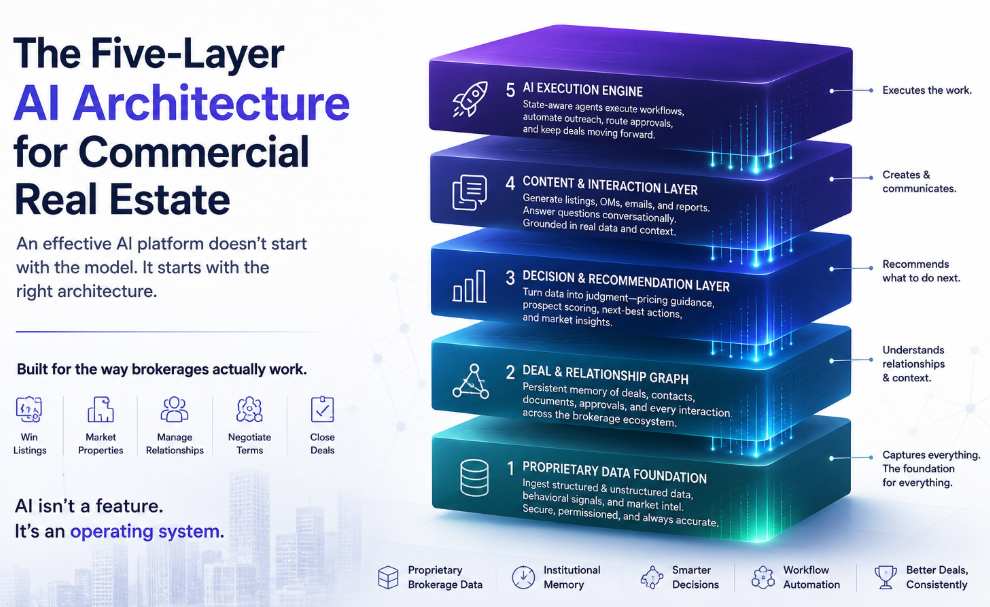
A CRE brokerage workflow is not one task, it's a chain: source the listing, price it, market it, field inbound interest, qualify prospects, negotiate terms, push the deal through approvals, and close. A broker-facing AI product that only answers questions in a chat window addresses none of that chain directly. To actually move a deal, the platform needs to be built as a stack, not a single feature, with each layer depending on the one below it.
#Everything above this layer is only as good as what gets captured here. This is where structured data (listings, rent rolls, comps, tenant and landlord contact records, lease terms) and unstructured data (LOIs, lease drafts, inspection reports, broker notes, email threads) get ingested alongside behavioral signals: which comps a broker actually used in a pricing decision, which prospects they prioritized, which recommendations they overrode and why.
The reason this has to be proprietary rather than borrowed from a general-purpose model is straightforward: no foundation model was trained on a specific brokerage's deal history, its landlord relationships, or the local market quirks a broker has learned over a decade. Permissions and access control also live at this layer, since a multi-broker platform has to enforce who can see which listings, which client relationships, and which deal terms.
Layer 2: Deal & Relationship Graph
A single deal touches a listing, a landlord, a tenant, a co-broker, a lender, legal counsel, and a sequence of state changes stretched across weeks or months. This layer is the persistent memory that holds all of it together: which documents belong to which deal, who approved what and when, how a negotiation evolved, and how a prospect moved from inquiry to LOI to signed lease.
Without this graph, every interaction starts cold. A broker asking "what did the landlord counter with last time" or "which of my contacts have looked at industrial space in this submarket before" needs a system that can actually traverse relationships and history, not one that re-reads whatever text happens to be in the current conversation.
Layer 3: Decision & Recommendation Layer
This is where accumulated deal history and market data get turned into judgment: suggested asking price based on live comps and absorption trends, which prospects in the pipeline are most likely to convert, which listings need a price adjustment, and what the next-best action is for a broker's day—call this landlord back, follow up on that stale lead, re-market this space with updated terms.
The recommendation layer is what separates a system that reports on the past from one that actively improves outcomes going forward. It's also the layer most exposed to trust: a pricing suggestion or prospect ranking is only useful if the broker can see the reasoning and the comps behind it, not just a number.
Layer 4: Content & Interaction Layer
This is the layer most people mistake for the whole product, because it's the most visible: generating listing flyers, offering memoranda, market update emails, tenant outreach, and answering a broker's questions conversationally. It matters—brokers spend real time on this content, and doing it well saves hours per week.
But on its own, this layer produces plausible-sounding output with no grounding in the actual deal, the actual comps, or the actual relationship history sitting in the layers below. A flyer generated without the data foundation and deal graph behind it is generic. A flyer generated with them is specific to the listing, the submarket, and the prospects most likely to respond.
Layer 5: AI Execution Engine
At the top of the stack is the layer that actually runs the workflow rather than describing it: state-aware agents that can draft and send outreach to a qualified prospect list, follow up automatically when a lead goes quiet, route a signed document for approval, and update the deal graph as each step completes—with retries and human-in-the-loop checkpoints where the workflow calls for broker judgment.
This is the difference between a tool a broker has to operate manually, step by step, and a system that executes the parts of the workflow that don't need a broker's personal touch, freeing the broker for the relationship and negotiation work that does.
Why the Layering Matters for a Broker Platform Specifically
Brokerage is a relationship business built on institutional memory—comps a broker trusts, landlords they've worked with for years, prospects they've tracked for months before a deal materializes. A platform that can't retain and reason over that memory is, at best, a faster typewriter. The five-layer structure is what lets a broker platform get sharper over time: every completed deal, every override, every closed loop between a recommendation and its outcome feeds back into the data foundation and deal graph, making the next pricing suggestion, the next prospect ranking, and the next piece of generated content better than the last.
Ready to see this on one of your listings?
Continue to Antela's Antela platform — or try the workflow with one listing and book a demo when you're ready.
Frequently asked questions
Where can I learn more?
Explore Antela platform at /.