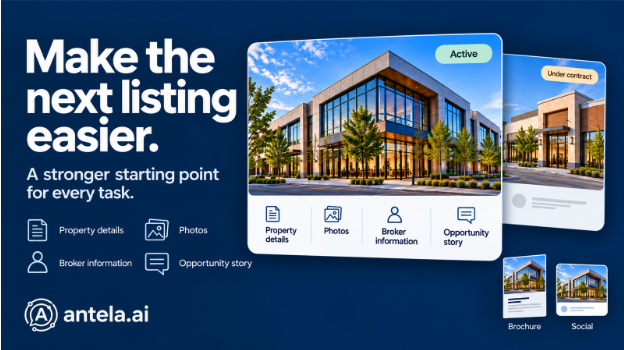
Getting a property listed is the beginning of the work.
The offering memorandum gets finished. The listing goes live. The first campaign goes out.
Then a prospect asks a question. Availability changes. New photos arrive. The broker wants a different angle for the next brochure.
Each task needs some of the same information—and someone has to know where to find it, whether it is current and how it should be used.
That is where the property portfolio becomes more than a collection of listings. It becomes a practical foundation for the work that follows.
The real adoption test comes during the next task
An impressive AI demo can show how quickly a tool produces a first draft. The more revealing test comes later, when a broker or marketing coordinator has another job to do.
Can they return to the property and find a useful starting point?
Or do they need to gather the files, explain the opportunity and supply the same background again?
A brokerage already has established tools and habits. A new platform earns a place in that working day when returning to it makes the next task easier.
A useful portfolio provides that reason to return—even between marketing projects.
A portfolio should help the brokerage see its business
A list of available properties serves an important purpose. A brokerage portfolio can provide a broader view.
Which properties are active? Which are under contract? Which have closed? Who represents each opportunity? What information is available for the next conversation or piece of work?
For a broker, that view connects the property to their responsibilities.
For marketing, it provides a starting point for understanding the opportunity and locating its supporting information.
For brokerage leadership, it brings properties and their status across agents into one view.
Historical properties can also remain useful as a record of the firm's experience. A completed transaction may support a future listing presentation or help the team explain its experience in an asset class or market.
The value continues as the property moves through its lifecycle.
One listing, several moments of value
Consider an office property represented by a brokerage.
The team has assembled the listing details, photographs, broker information and a description of the opportunity. An OM has been created and approved.
Two weeks later, the broker needs a shorter brochure for a different audience.
Without a maintained property foundation, marketing may start by opening the OM, extracting information, searching for the original photos, and asking the broker which details still apply.
With that foundation, the team can begin with the property's information, review what has changed and create the next asset from a clearer starting point.
Later, availability changes. The team needs to verify the update before using it in new materials.
When the property goes under contract, its status should remain visible to the people responsible for it. After closing, the brokerage can retain a useful record of the transaction.
These are separate tasks, but they belong to the same property. Keeping that connection intact reduces the need to reconstruct its story each time.
Carry forward facts, positioning and decisions
Better CRE AI depends on the quality of the context available to it. That context includes several different kinds of information.
Facts need verification. Square footage, availability, pricing, property features and broker contact information need clear sources and current values. An earlier document can be useful evidence, but its age and accuracy still matter.
Positioning needs judgment. The story of an opportunity depends on its audience. An owner-user may care about different features than an investor. Preserving the broker's perspective gives the next task a stronger starting point; it should still be reviewed for the audience at hand.
Decisions need context. An approved revision may reflect a client preference, a corrected fact, or a change in strategy. Those reasons can matter as much as the final wording.
A mature property workflow should preserve these distinctions. AI can help people use the information, while brokers and marketing teams remain responsible for reviewing what carries forward.
A property record alone does not make every future output accurate. It gives the team a place to maintain and review the inputs.
Measure whether the next task gets easier
Brokerages can evaluate this approach through a few practical questions:
- Repeat use: Do brokers and marketing staff return to the property between projects?
- Time to begin: How long does it take to find the information needed and start the next task?
- Repeated input: How often does someone re-enter a fact, upload the same photo, or explain the opportunity again?
- Portfolio visibility: Can the team identify property status and responsibility across agents?
- Review quality: Are outdated details and unsupported claims caught before publication?
Together, these measures show whether the portfolio is becoming useful in the brokerage's everyday work.
Start with a few properties and one real task
A practical starting point is a small group of active properties.
Bring together their details, photos, representing brokers, status and opportunity descriptions. Review the information with the people who know those properties.
Then complete one real task: create a brochure, prepare social content, or assemble information for a client conversation.
Observe what the team can reuse, what it must supply again and what needs correction. Use those findings to improve the property foundation before expanding the process.
At Antela, this is why we put the property portfolio at the center of the experience. Brokerages can bring their properties together, build their brokerage presence and use property information as a starting point for ongoing marketing work.
Every property. Every agent. A foundation the team can keep building on.
Start with your own properties at antela.ai. Prefer a guided introduction? Contact us for a walkthrough.
Ready to put your portfolio to work?
Start with your own properties at Antela. Prefer a guided introduction? Contact us for a walkthrough.
Frequently asked questions
Why is the next task a better test of CRE AI than a first-draft demo?
A demo can show how quickly a tool produces a first draft. The more revealing test comes later, when a broker or marketing coordinator has another job to do. Can they return to the property and find a useful starting point, or do they need to gather the files, explain the opportunity, and supply the same background again?
What should a brokerage portfolio show beyond available listings?
A useful portfolio shows which properties are active, under contract, or closed, who represents each opportunity, and what information is available for the next conversation or piece of work. Historical properties can also remain as a record of the firm's experience in an asset class or market.
How can one listing support more than one marketing task?
The same property may need an offering memorandum, a shorter brochure for a different audience, an availability update, and a status change when it goes under contract. Those are separate tasks, but they belong to the same property. A maintained foundation lets the team review what has changed instead of reconstructing the story each time.
What is the difference between facts, positioning, and decisions?
Facts need verification: square footage, availability, pricing, property features, and broker contact information need clear sources and current values. Positioning needs judgment and depends on the audience. Decisions need context, because an approved revision may reflect a client preference, a corrected fact, or a change in strategy.
How can a brokerage tell whether its property portfolio is becoming useful?
Look at whether people return to the property between projects, how long it takes to start the next task, how often someone re-enters a fact or re-explains the opportunity, whether the team can see status and responsibility across agents, and whether outdated details are caught before publication.
Related Reading
More in InsightsMarketing
CRE Marketing Software Buyer's Guide
A practical buyer's guide to commercial real estate marketing software: the capabilities that matter, pricing models, pilots, and buying mistakes.
Marketing
How to Automate Commercial Real Estate Marketing
A practical guide to automating commercial real estate marketing: listing data, document production, distribution, follow-up, and human review.
Marketing
CRE Marketing Workflow Checklist
A phase-by-phase commercial real estate marketing checklist covering intake, asset production, launch, follow-up, and closeout for every listing.
Marketing
Best Marketing Software for Brokerage Teams
What CRE brokerage teams should look for in marketing software: shared data, brand control, approvals, seat economics, and fit by team size.
Marketing
How Boutique Brokerages Scale Marketing
How small CRE brokerages produce institutional-quality marketing without adding headcount: standardization, reusable data, tiered assets, and cadence.