The finished file is a dead end
An offering memorandum gets completed. A brochure gets approved. A campaign goes out. In most brokerage workflows, that is where the system's knowledge of the work ends. The output exists, the project is closed, and the context lives inside the files.
But the property has months of work ahead of it. A new photo arrives. Availability changes. The broker adjusts the positioning. Another marketing asset is needed.
When useful context lives only inside finished artifacts, the next task starts with archaeology:
- Which details are current?
- Which image should we use?
- What did the broker approve?
- Why did the team describe the opportunity that way?
This is a product design problem. The system was organized around the deliverable, when the durable unit is the property.
The cost is real for brokerages. Every rebuild of context is broker and marketing-team time spent re-deriving what the team already knew, and every inconsistency between an OM and a flyer is a credibility risk in front of a client.
Principle: the property is the unit of continuity
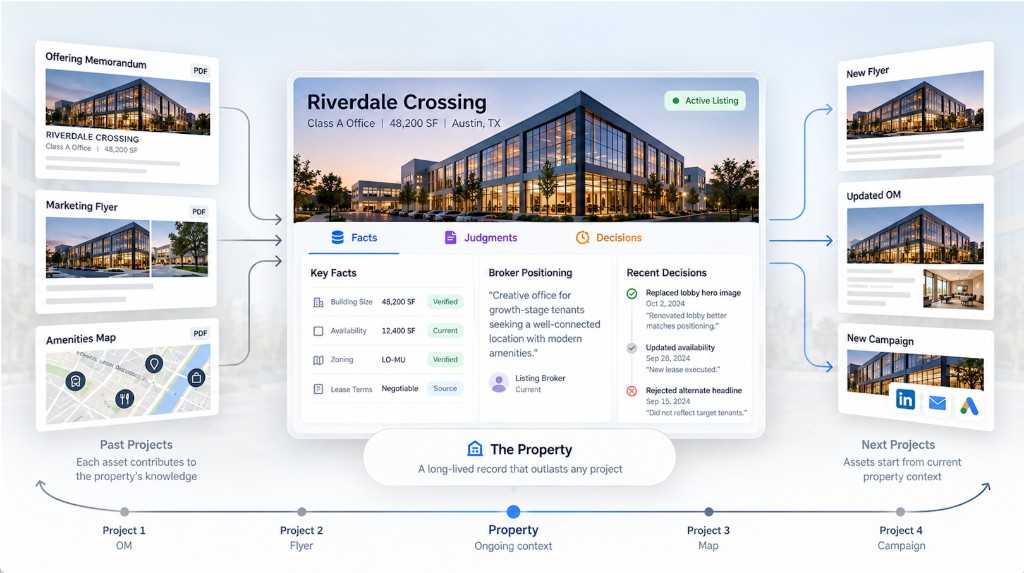
Most marketing tooling is project-shaped: a project produces an asset, and the asset is the record. We invert that. The property is a long-lived entity, and projects are episodes in its lifecycle. Every OM, flyer, map, and campaign reads from the property and contributes back to it, rather than carrying a private copy of the truth.
Without a durable property record, every new asset forks the data.
The square footage in the OM and the square footage in the flyer become two facts that happen to agree until they don't.
Not all context is the same kind of thing
Treating "property context" as one undifferentiated blob fails quickly. The information that should carry forward falls into at least three categories with different semantics.
Facts are things to verify. Square footage, suite availability, zoning, lease terms. A fact has a source, a verification state, and often a shelf life. The right treatment is provenance, freshness, and a clear flag when a value conflicts with a newer source.
Judgments are things to preserve. How the broker positions the asset, which tenants and buyers it targets, what is emphasized and what is downplayed. A judgment can't be verified against an outside source, and automation should not "correct" it. The right treatment is attribution and stability: it carries forward until a person changes it.
Decisions are things to explain. An approved revision, a rejected image, a reworded headline. A decision has an author, a time, and most valuably a reason. The right treatment is an append-only record that informs the next person's choice.
A schematic illustration, not a shipped schema:
fact:      { field: "rentable_sf", value: 48200,
             source: "rent roll", verified: true, as_of: "2026-09-30" }

judgment:  { topic: "positioning", text: "Creative office for growth-stage tenants",
             owner: "listing broker", status: "current" }

decision:  { change: "Replaced lobby hero image",
             approved_by: "broker", rationale: "Renovated lobby better matches positioning" }
A system that treats all three as "text in a document" cannot answer what should be rechecked, what should be left alone, and what should be understood before it is changed.
Why the distinctions matter for AI
Language models produce fluent output from whatever context they are given, but they are far less reliable at knowing what kind of context they were given. If a stale fact, a broker's positioning, and last month's rejected draft arrive as undifferentiated prose, the model blends them with equal confidence.
Keeping the categories separate lets each get the right behavior:
- Facts can be checked against sources and flagged when stale or in conflict.
- Judgments can constrain tone and emphasis without being silently rewritten.
- Decisions can inform suggestions, so the system does not re-propose what a broker already rejected.
Anything that persists across projects should also be inspectable and correctable by the person accountable for it. Persistent context without review is just a more durable way to be wrong.
Design commitments
- Property-first data model. Assets are views over, and contributors to, a property record.
- Provenance on everything that carries forward. Every value is traceable to its source and approver.
- Different lifecycles for different information. Facts expire and get re-verified, judgments persist until their owner changes them, and decisions accumulate.
- Human review at the point of carry-forward. A person confirms what becomes durable context.
- Workflow built around the property. Checklists, approvals, and asset generation attach to the property's state, not a one-off project folder.
What this means for brokerages
For a brokerage, this design direction translates into outcomes you can hold a vendor to:
- Faster next asset. The flyer, map, or revised OM starts from the property's current state, not from a folder of old files.
- Consistency across assets. One source of truth for facts means fewer mismatches between what the OM says and what the flyer says.
- Broker judgment stays the broker's. Positioning is preserved and attributed, not regenerated differently each time.
- Reviewable AI. Your team sees and confirms what carries forward.
At Antela, we are building AI-native workflows for CRE brokers across listing creation, OM production, amenities maps, and marketing assets. This principle is the standard we hold that roadmap against. It does not mean every form of decision memory or cross-system automation exists in the product today. Where capabilities are shipped, we say so plainly.
Working with design partners
We are shaping this with brokerages and teams who feel the reconstruction problem daily. If your team rebuilds property context between projects and wants a say in how it should work, we would like to talk. Schedule a conversation, or write to contact@antela.ai.
The measure of success
Each completed project should leave the team better prepared for the next one. The OM should make the flyer easier, the flyer should make the next revision faster, and a broker's judgment should never have to be re-explained.
Get started for free today
If your team rebuilds property context between projects, the fastest way to see how we are approaching it is to try Antela.ai. Start with a listing, an OM, or an amenities map, and see what a property-centered workflow feels like in practice.
Building AI systems on long-lived entities, or want to compare notes on provenance and carry-forward review? Write to us at contact@antela.ai. We read every message.
If your team rebuilds property context between projects, we would like to talk.
Antela is building property-centered workflows for listing creation, offering memorandums, amenities maps, and marketing assets. This article describes a design direction. Where capabilities are shipped, we say so plainly.
Frequently asked questions
Why is a finished marketing file a dead end in CRE workflows?
An offering memorandum, brochure, or campaign usually stores the work inside the finished file. Once the project is closed, the next photo, availability change, or positioning adjustment has no durable record to start from. The team has to reconstruct which details are current, which image to use, what was approved, and why the opportunity was described that way.
What does it mean for the property to be the unit of continuity?
The property is a long-lived entity, and projects are episodes in its lifecycle. Every offering memorandum, flyer, map, and campaign should read from the property record and contribute back to it, rather than carrying a private copy of the truth.
What is the difference between facts, judgments, and decisions in property context?
Facts are things to verify, such as square footage, suite availability, zoning, and lease terms. They need provenance, freshness, and a flag when a newer source conflicts. Judgments are things to preserve, such as positioning and target tenants. They should carry forward until a person changes them. Decisions are things to explain, such as an approved revision or a rejected image. They need an author, a time, and a reason.
Why should AI treat facts, judgments, and decisions differently?
Language models produce fluent output from whatever context they are given, and they are less reliable at knowing what kind of context that was. If a stale fact, a broker's positioning, and a rejected draft arrive as undifferentiated prose, the model blends them with equal confidence. Separate categories let facts be checked, judgments constrain tone without being rewritten, and decisions stop the system from re-proposing what a broker already rejected.
Does this article describe capabilities that are already shipped?
No. This article describes a design direction, not a feature inventory. Not every capability discussed here is shipped. At Antela, the principle is the standard the roadmap is held against. Where capabilities are shipped, the product says so plainly.
Related Reading
More in MarketingMarketing
The Hidden Cost of CRE Marketing Handoffs
Most CRE teams do not lose the most time writing the first draft. They lose it in the handoffs, re-entry, and revision work that happens before and after.
Marketing
One OM. Three Revisions.
A price change is one line. The real cost of a CRE marketing update is the coordination tax it triggers across the OM, brochure, campaign, and listing page.
Marketing
CRE Marketing Software Buyer's Guide
A practical buyer's guide to commercial real estate marketing software: the capabilities that matter, pricing models, pilots, and buying mistakes.
Marketing
How to Automate Commercial Real Estate Marketing
A practical guide to automating commercial real estate marketing: listing data, document production, distribution, follow-up, and human review.
Marketing
CRE Marketing Workflow Checklist
A phase-by-phase commercial real estate marketing checklist covering intake, asset production, launch, follow-up, and closeout for every listing.