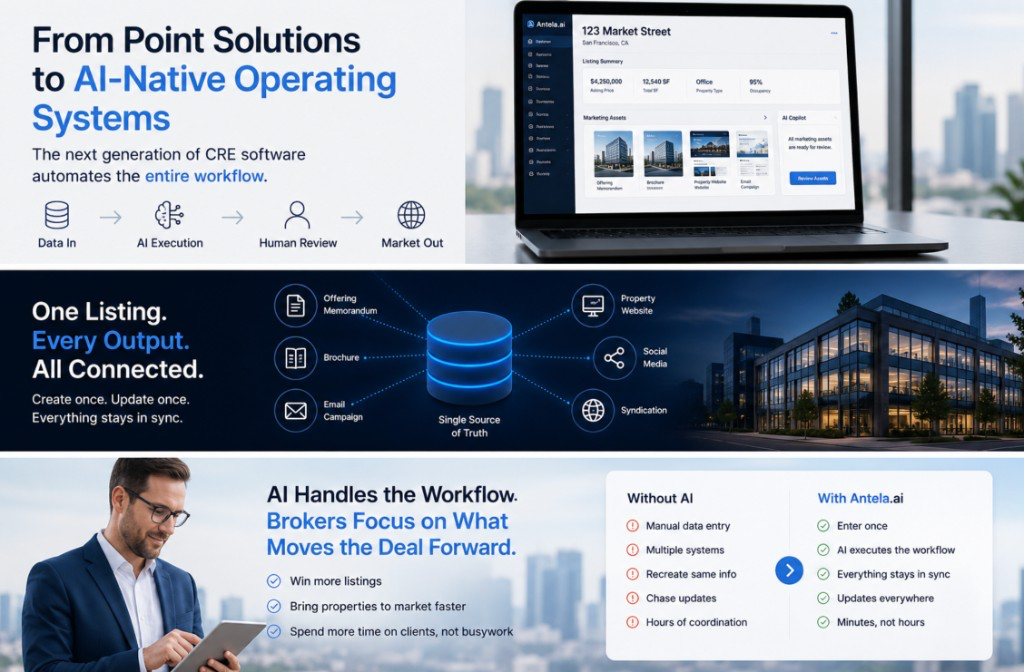
Commercial real estate has spent two decades digitizing itself. CRMs replaced contact spreadsheets. Listing platforms replaced binders. Marketing tools replaced manual brochure layout. Syndication networks replaced faxing flyers to every broker in town.
And yet, walk into most brokerages today and you'll still find someone doing the same thing brokers were doing in 2005: manually moving the same property information from one system to the next.
That's the gap this piece is about. Digitization and automation are not the same thing, and the difference matters more now than it ever has.
Digitizing a task isn't the same as automating a workflow
A brochure generated from a template is a digitized brochure. It's faster to produce than one built by hand — but someone still has to pull the listing data, drop it into the template, check it, then go do the same thing again for the offering memorandum, the property website, the email blast, and the syndication feed.
The property is the same. The information is the same. But it passes through five tools and however many human hands before it reaches the market.
That person, doing the copying, checking, and reconciling between systems, is functioning as human middleware — the integration layer that software vendors never quite built. A brokerage can be fully digitized and still only partially automated, because digitization speeds up individual steps without connecting them.
Three levels of AI, and why the label matters
Not all "AI-powered" CRE software is doing the same job. It's worth separating three levels:
Level 1 — AI-assisted tasks. AI speeds up one thing: writing a property description, summarizing a lease, extracting numbers from a rent roll. The workflow around it doesn't change.
Level 2 — AI-assisted workflows. AI carries information across a few connected steps — say, pulling data from a source document straight into an OM, brochure, and email campaign. Humans still run the process, but fewer handoffs require manual re-entry.
Level 3 — AI-native operating systems. AI becomes part of the architecture itself. The system tracks the state of a listing, knows what needs to happen next, generates or triggers it, and routes things to a human only when judgment or approval is genuinely required.
The shift is from AI helping with a task, to AI helping with a workflow, to AI participating in running the workflow. Most "AI features" bolted onto legacy CRE software live at Level 1. The real architectural change happens at Level 3 — what we mean by a commercial real estate operating system.
Treat the listing as one object, not five documents
Here's the principle underneath a true operating-system approach: an offering memorandum, a brochure, a property website, an email campaign, and a social post aren't five separate documents. They're five views of the same underlying property.
Most brokerage software doesn't treat them that way — it treats each as its own production process, which means every price change, every updated photo, every new comp has to be hunted down and re-entered everywhere it appears.
The alternative is simple in concept: source documents and broker input feed a single structured listing record, and every downstream artifact — BOV, OM, brochure, website, email, social, syndication — is generated from that record, not rebuilt independently for each channel. AI is what makes this possible at scale, because most of what enters a brokerage workflow starts as unstructured material: PDFs, rent rolls, photos, notes, emails. Turning that into structured data once, instead of five times, removes a huge share of the manual work.
The clock starts before you win the listing
It's tempting to think automation only matters once you've got the mandate. But a lot of the highest-leverage work happens earlier — researching the opportunity, building comps, producing a BOV, and pitching the client to win the assignment in the first place.
That stage runs on speed as much as substance. A sharp BOV delivered two days late loses to an adequate one delivered same-day. If AI lets a broker turn research into a data-backed valuation and a client-ready pitch in minutes instead of days, that's not just an efficiency gain — it's a competitive one. It changes whether you're in the room at all.
Automation doesn't mean removing the broker
None of this replaces judgment. Reading a market, understanding what a client actually wants, positioning an asset correctly, negotiating, building the relationship, signing off on what goes out the door — that's still squarely human work, and probably always will be.
The more useful question isn't "what can AI replace," it's: which parts of a broker's week exist because the work genuinely requires judgment, and which parts exist only because the software couldn't coordinate itself? AI-native systems let you separate those two things — automating the extraction, generation, and routing, while keeping direction, exceptions, and approval with the human.
That looks less like:
Human input → human production → human transfer → human verification → human distribution
and more like:
Human direction → AI execution → human review → system distribution
What this could mean for how brokerages are staffed
Brokerages have historically absorbed fragmented software by adding people — marketing coordinators, operations staff, researchers — whose real job, underneath the title, is often connecting systems that don't talk to each other.
Workflow-level automation loosens the relationship between deal volume and headcount. A firm can grow output without growing administrative overhead at the same rate. That matters most for boutique and mid-sized brokerages, which have never had the option of throwing large ops teams at the problem the way bigger firms can. AI-native tooling gives smaller shops a real path to operating with the coordination capacity of a much larger one.
Judge software by the workflow, not the feature list
Most CRE software gets evaluated with a checklist: does it have a CRM, does it make brochures, does it do email, does it syndicate. Those questions still matter, but they miss the point — a platform can check every box and still require a person to manually stitch each feature to the next.
A better question: how many human interventions does it take to move a listing from opportunity to market? Worth tracking: time from opportunity to a finished BOV, time from listing creation to a complete marketing package, how many times the same data gets typed in twice, how many systems and handoffs a single listing touches, and how long it takes a single change to propagate everywhere it needs to.
That's a workflow evaluation, not a feature evaluation — and it's the more honest way to compare tools as AI functionality becomes table stakes everywhere. For a practical scorecard, see how to evaluate CRE brokerage software.
Where Antela fits
This is the model we're building Antela around: a shared property and workflow context that runs from pre-listing research through listing creation, marketing, collaboration, syndication, and lead management — instead of a stack of point solutions a broker has to hold together manually.
In practice, that means each stage of the workflow described above maps to a piece of the platform, all pulling from the same underlying listing record:
- Listing Center — where source documents and broker input become a single structured listing record.
- Marketing Center — turns that record into brochures, OMs, maps, newsletters, and campaigns without rebuilding each one from scratch.
- Leads Center (CRM) — keeps inbound interest and follow-up connected to the listing instead of living in a separate system.
- Document Center — handles the unstructured material a deal starts with: PDFs, rent rolls, leases, notes.
- AI Copilot — the layer that executes routine steps and flags what needs human judgment or approval.
- Antela Smart Syndication — pushes the listing out to syndication once, from the same record everything else was built from.
It's the architecture we believe the category is moving toward, and Antela is built to run it end to end — not as a bet on where things might go, but as the platform already doing it. Explore the commercial real estate operating system, or compare brokerage software vs a CRE operating system.
The bigger question
CRE software's first era was about digitizing individual activities. The next one is about connecting and running the workflow between them.
The question worth sitting with isn't "how can AI help a broker finish a task faster." It's: how should a brokerage operate once software can participate in running the workflow itself? That's the real shift behind the AI-native operating system — and it's still early enough that there's plenty of room for brokerages, and the tools they choose, to shape how it plays out.
For a look at how this is already showing up for customers, continue to What This Looks Like in Practice: How Antela Is Helping CRE Teams.
Ready to see this on one of your listings?
Continue to Antela's commercial real estate operating system — or try the workflow with one listing and book a demo when you're ready.
Frequently asked questions
What is an AI-native operating system for CRE?
An AI-native CRE operating system treats the listing as one shared record and uses AI as part of the architecture—tracking state, generating downstream assets, and routing work to humans only when judgment or approval is required—rather than bolting AI features onto disconnected point solutions.
How is digitization different from automation?
Digitization speeds up individual steps (for example, a brochure template). Automation connects those steps so the same property data flows into the OM, brochure, website, email, and syndication without manual re-entry between tools.
Does an AI-native OS replace brokers?
No. It automates extraction, generation, and routing so brokers spend time on judgment, positioning, negotiation, relationships, and approval—not copying the same listing data between systems.
Related Reading
More in BrokerageBrokerage
What This Looks Like in Practice: How Antela Is Helping CRE Teams
The shift toward an AI-native brokerage isn't theoretical. Here's how CRE teams use Antela to win listings, bring properties to market faster, and scale without adding overhead.
Brokerage
Brokerage Software vs CRE Operating System
How commercial real estate brokerage software differs from a CRE operating system—and how to choose the right evaluation lens.
Brokerage
What Is a Commercial Real Estate Operating System?
A clear definition of a commercial real estate operating system—how it differs from CRM and marketing suites, and how brokerages evaluate one.
Brokerage
How to Evaluate CRE Brokerage Software
A practical scorecard for evaluating commercial real estate brokerage software: workflows, brand controls, CRM linkage, pricing, and pilots.