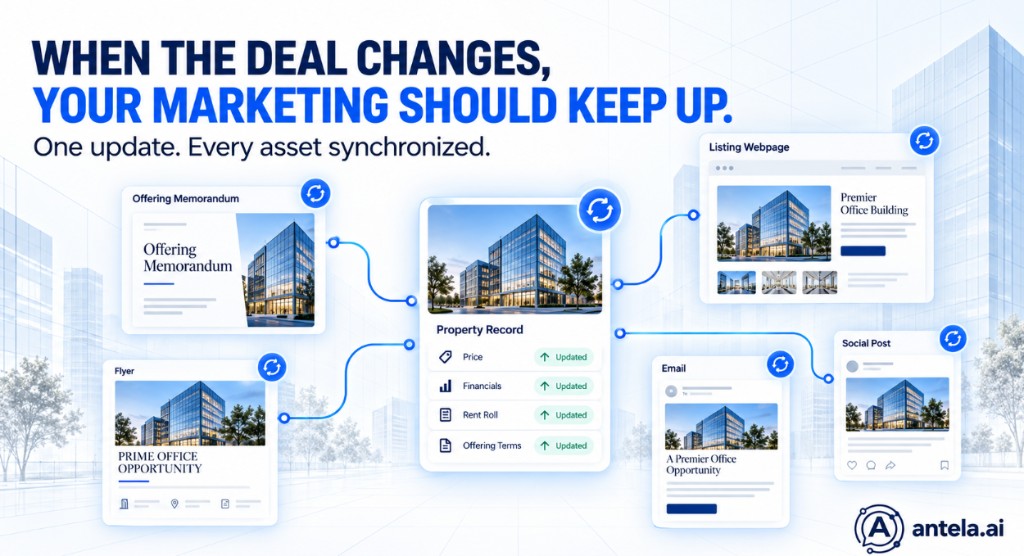
Commercial real estate marketing is often priced and managed as if it were a one-time production job.
Send the property information to a marketing agency. Wait for the first draft. Review it. Request changes. Approve the final offering memorandum. Move on.
But that is rarely how a real deal works.
An OM is not a static document. It is a living representation of a listing—and the listing continues to change throughout the deal lifecycle.
The asking price may change. A tenant may renew, vacate, or sign a new lease. The rent roll may be updated. New trailing financials may become available. The seller may revise the offering terms or extend a deadline.
Every time the deal changes, the marketing needs to change with it.
One change can create work across the entire campaign
Consider what can change while a property is being marketed:
- Asking price or pricing guidance
- Net operating income, cap rate, or financial projections
- Rent roll, occupancy, or tenant information
- Lease terms and expiration dates
- T-12 financials and operating expenses
- Financing assumptions
- Property improvements or renovations
- Photography, maps, and market information
- Offering terms and submission deadlines
- Broker contacts, disclosures, or disclaimers
- Property availability or deal status
These are not simply edits to one PDF.
The same information may appear in the OM, flyer, listing page, email campaign, social media graphics, digital postcard, and other marketing materials. When one fact changes, every asset containing that fact may need to be identified, updated, reviewed, and redistributed.
That is where the real operational cost begins.
The first OM is only the beginning
Imagine that an agency takes several business days to produce the first version of an OM.
The owner reviews it and requests a change. The broker sends the feedback to the marketing team. The marketing team briefs the agency. The agency places the request in its production queue, updates the document, and sends it back for review.
Then the asking price changes.
Later, a tenant renews and the rent roll must be updated.
Finally, the seller changes the offer deadline.
Each update can trigger another email chain, handoff, production cycle, and approval round. A document that initially took days to produce can require multiple updates over several weeks or months.
Now multiply that process across every active listing—and across every asset associated with each listing.
The hidden cost is bigger than the agency invoice
Agency fees are easy to see. The operational costs created around them are not.
There is the broker’s time spent explaining changes. The coordinator’s time spent locating every affected asset. The delay while the request waits in an external production queue. The review cycle required to confirm that the change was made correctly.
There is also the risk that one asset gets updated while another does not.
The OM may show the new asking price while the flyer still shows the old one. The listing page may contain the latest offer deadline while an earlier social post continues circulating with outdated information. A prospect may receive an old version from someone who did not realize that a newer file existed.
At that point, the problem is no longer design efficiency. It is accuracy, credibility, and client experience—the same failure mode that shows up in common OM mistakes like version chaos and stale figures.
Your outsourced workflow becomes your client’s experience
Owners do not care how many people or companies are involved in producing their marketing.
They want to know:
- Is the information accurate?
- How quickly can a change be made?
- Are all marketing materials consistent?
- When will the updated campaign be live?
Telling a client, “We sent it to the marketing agency,” does not make the delay disappear.
From the client’s perspective, the brokerage owns the outcome. Every slow update, missed change, or inconsistent asset becomes part of the experience the brokerage delivers.
From document production to lifecycle management
This is why CRE brokerages need more than a faster way to design an OM.
They need a system that connects property data to the materials created from it.
With a traditional outsourced workflow, a change can look like this:
Change deal information → Notify the marketing team → Brief the agency → Wait for production → Review the output → Request corrections → Update each additional asset
With Antela, the workflow becomes:
Update the listing information → Generate or refresh the marketing materials using the current data
The brokerage keeps control of the process. Teams can create the first version faster, respond to owner requests immediately, and keep materials aligned as the deal evolves—the same shift described in how to automate commercial real estate marketing.
Antela is not simply helping brokerages create another PDF. It is helping them manage the marketing lifecycle of the listing—from the first pitch through every subsequent change.
One source of truth, many synchronized outcomes
The future of CRE marketing is not sending the same property information through a new production process every time something changes.
It is maintaining one reliable source of listing information and using it to create the materials needed throughout the deal.
That means fewer handoffs, faster updates, and greater consistency across the campaign. It also means brokers and marketing teams spend less time coordinating production and more time serving clients and moving deals forward.
Because an OM is not a one-time project.
It is one part of a living deal—and your marketing system should be able to keep up with it.
How quickly can your brokerage update an OM, flyer, listing page, and campaign when the deal changes? If the answer is measured in days or weeks, let’s talk.
Keep every listing asset in sync
Update the listing once and refresh the OM, flyer, listing page, and campaign from current data—without another agency production cycle.
Frequently asked questions
Why isn’t an offering memorandum a one-time project?
Because the listing keeps changing after the first draft. Asking price, rent roll, financials, offering terms, deadlines, photography, and deal status can all shift while the property is on the market—and every change may need to flow into the OM and related marketing assets.
What creates the hidden cost of updating CRE marketing?
Agency fees are visible. The hidden cost is broker and coordinator time explaining changes, finding every affected asset, waiting in an external production queue, running review cycles, and managing the risk that one asset gets updated while another does not.
Why do inconsistent marketing assets hurt a brokerage?
Prospects and owners experience the brokerage as the owner of the outcome. An OM with a new asking price next to a flyer with the old one is not just a design problem—it damages accuracy, credibility, and client experience.
How does Antela change the update workflow?
Instead of briefing an agency and waiting for another production cycle for each change, teams update the listing information and generate or refresh marketing materials from current data. The brokerage keeps control and can keep the campaign aligned as the deal evolves.
What marketing assets typically need to stay synchronized?
The same facts often appear in the offering memorandum, flyer, listing page, email campaign, social graphics, digital postcard, and other materials. When one fact changes, every asset that contains it may need to be identified, updated, reviewed, and redistributed.
Related Reading
More in Offering MemorandumOffering Memorandum
How to Create an Offering Memorandum
A step-by-step guide to creating a commercial real estate offering memorandum: structure, data gathering, financials, design, review, and disclaimers.
Offering Memorandum
Offering Memorandum Template
A section-by-section offering memorandum template for commercial real estate, with page counts, asset-type variations, and what to keep dynamic.
Offering Memorandum
Offering Memorandum Checklist
A pre-send offering memorandum checklist covering source data, content, financial reconciliation, brand consistency, legal language, and final review.
Offering Memorandum
OM vs Brochure
OM vs brochure in commercial real estate: what each document does, how they differ, when you need both, and how to produce them from one dataset.
Offering Memorandum
Common OM Mistakes
The offering memorandum mistakes that cost CRE deals credibility: reconciliation errors, buried theses, stale data, weak disclaimers, and version chaos.