
What an offering memorandum is for
An offering memorandum has one job: give a qualified investor everything they need to decide whether to spend more time on the deal.
That framing matters because it explains what belongs in the document and what does not. An investor reading your memorandum is trying to answer four questions quickly:
- What is the asset, and where?
- What does it earn today, and what could it earn?
- What are the risks I should be worried about?
- Why is this being sold, and what is the process?
Everything in a good memorandum serves one of those questions. Content that serves none of them makes the document longer without making it more persuasive, and experienced investors skim past it.
The second thing to understand is that a memorandum is a liability document as much as a marketing document. Every number in it is something a buyer may rely on. That constraint shapes the review process described at the end of this guide.
The standard OM structure
The sequence below is conventional for good reason: investors reading several memorandums a week can navigate a familiar structure without effort.
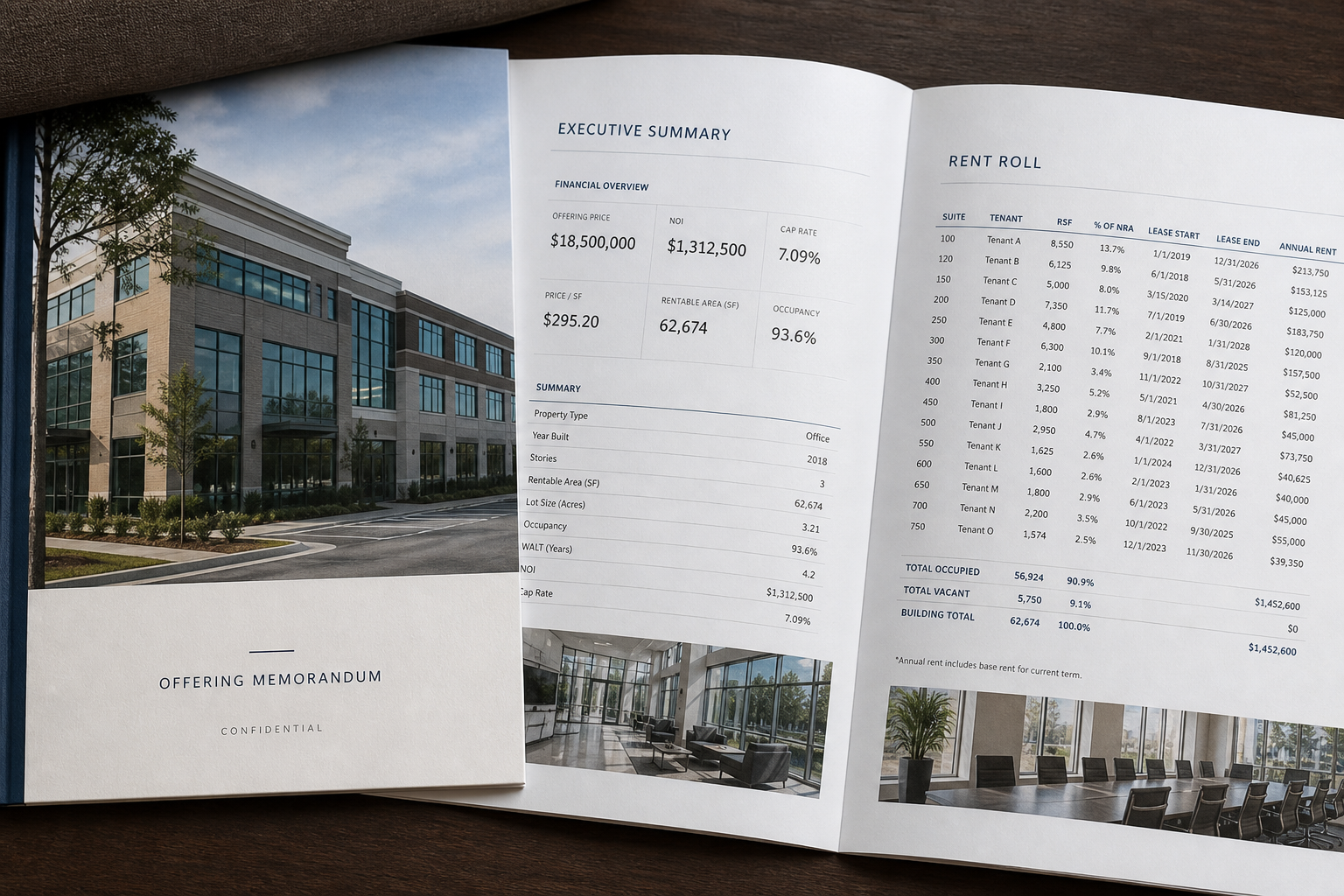
1. Cover and confidentiality statement. Property image, address, asset type, and the confidentiality notice. Clean and professional; this sets expectations.
2. Executive summary. One or two pages. The offering in brief: asset, size, price, cap rate, occupancy, and the three to five reasons this deal is worth attention. Many investors decide whether to keep reading here.
3. Investment highlights. Three to seven specific, evidenced points. Not adjectives.
4. Property overview. Address, parcel data, year built, renovations, building and land size, construction type, parking, zoning, and condition.
5. Tenancy. Rent roll, lease abstracts for major tenants, expiration schedule, escalations, options, and tenant credit where relevant.
6. Financial analysis. Trailing 12-month operating statement, current in-place income, pro forma, and pricing metrics with assumptions stated.
7. Market and location. Submarket overview, demographics, traffic counts, employment drivers, and comparable sales or leases.
8. Offering process. How to submit interest, the timeline, tour arrangements, and contact details.
9. Disclaimers. Full legal language, not an afterthought.
Our offering memorandum template guide expands each of these into a reusable outline.
Gathering the underlying data
Most of the elapsed time in producing a memorandum is spent here, and most of it is avoidable.
Request everything at once. A single, standard document list sent to the owner at engagement:
- Current rent roll, dated
- Trailing 12-month operating statement, ideally with 24 months of history
- Leases or lease abstracts for all major tenants
- Property tax bills and current assessment
- Survey, site plan, and floor plans
- Environmental and engineering reports if available
- Capital expenditure history and any planned work
- Service contracts and utility history
- Prior offering memorandum if the asset has traded
- Photography and any existing marketing material
Structure it before you write. Every figure that will appear in the memorandum should exist in one place, with a traceable source. Doing this properly means the financial tables, the executive summary, and the brochure cannot disagree with each other.
Extraction versus transcription. Retyping a 40-line rent roll is slow and error-prone. Reading it into a structured record automatically and reviewing the result is considerably faster and, in practice, more accurate than manual entry. Our guide on how AI creates an offering memorandum covers that pipeline and its limits.
Verify before you build. Rent roll totals reconcile to the operating statement. Occupancy matches the tenancy detail. Square footage is consistent across every mention. Expirations and options are dated correctly. Do this once, at the start, rather than discovering an inconsistency during a buyer call.
Writing the investment thesis
This is the part no software should write for you, and the part most memorandums handle worst.
The thesis is a single clear argument for why this asset is worth this price to this buyer. It should be stated in the executive summary and then supported by the rest of the document.
Strong theses are specific and evidenced. "In-place rents average 18 percent below the five most recent comparable leases in the submarket, with 62 percent of the rent roll expiring within 30 months." That is a thesis a buyer can test.
Weak theses are adjectives. "Excellent location with tremendous upside potential in a growing market." Every memorandum says this, which means it carries no information.
Match the thesis to the buyer. A stabilized net lease asset sold to a private 1031 buyer is a durability story: credit, term, and passive income. A value-add multi-tenant asset sold to a regional operator is an execution story: below-market rents, near-term rollover, and a specific plan. Writing the wrong story for the audience wastes the deal's best feature.
Address the obvious objection directly. Every asset has one: a short remaining term, deferred maintenance, a concentrated tenant, a soft submarket. Naming it and answering it builds more credibility than omitting it, because the buyer will find it anyway during diligence.
Financials that survive scrutiny
The financial section is where credibility is won or lost.
Show actuals and pro forma separately. Blending in-place performance with projected performance is the fastest way to lose a sophisticated buyer's trust. Label clearly.
State every assumption. Market rent, vacancy factor, expense growth, management fee, reserves, lease-up timing. An assumption you do not state is one the buyer assumes is hidden.
Reconcile everything. The rent roll total should equal the income line. Expenses should tie to the operating statement. Occupancy should match tenancy. Reconciliation errors are the most common and most damaging problem in memorandums, covered further in our common OM mistakes guide.
Be conservative on projections. An aggressive pro forma that a buyer disproves in twenty minutes damages every other number in the document.
Include the pricing metrics buyers expect for the asset type: cap rate on in-place and pro forma, price per square foot or per unit, and gross rent multiplier where conventional.
Market and demographic analysis
Keep this section short and relevant. Investors skip generic market commentary.
Include only what supports the thesis: submarket vacancy and rent trends, demographics within the trade area radius that matters for the asset type, traffic counts for retail, employment drivers for office and industrial, and recent comparable sales or leases with enough detail to be checkable.
Date everything. Demographic figures without a source and date are treated as decoration, and stale market data is one of the easiest ways to signal that the memorandum was assembled rather than researched.
Design, branding, and export
Design should make the document easy to read, not impressive.
- Consistent typography and hierarchy so scanning works
- Financial tables that are legible at print size and on a tablet
- Photography that shows the asset honestly, including the parts a buyer will see on tour
- Maps at useful zoom levels, both site context and trade area
- Fixed brand elements: logo placement, color, and contact block
- Page numbers and a table of contents for anything over 20 pages
Export both a full version and, where the offering is confidential, a redacted or teaser version. Producing both from the same underlying data avoids the classic error of a redacted version that still contains a tenant name in a chart label.
Offering memorandum software covers generating branded, consistent output from structured data rather than rebuilding layout for each listing.
Review, disclaimers, and distribution
The review process. Three passes, minimum:
- Numbers. The analyst verifies every figure against source documents.
- Narrative and positioning. The listing broker confirms the thesis and the objection handling.
- Cold read. Someone uninvolved reads it start to finish looking for confusion, not errors.
Our offering memorandum checklist is built for this stage.
Disclaimers. Standard language covering the confidential nature of the material, the absence of representations or warranties, the buyer's obligation to conduct independent diligence, and the seller's right to withdraw. Have counsel approve your standard language once, then lock it in your template so it cannot be edited accidentally.
Distribution. Decide what goes out freely and what requires a signed confidentiality agreement. A one-page teaser circulates broadly; the full memorandum typically follows execution. Track who received what, both for follow-up and for the record.
Whether the memorandum is a standalone document or one part of a coordinated launch matters too. Our guide to OM vs brochure covers choosing the right document, and AI-powered commercial real estate marketing software covers producing the full campaign from the same data.
The most useful thing you can do next is produce one and time it. Try with one listing using a real rent roll, or book a demo to see the workflow on your own asset. More detail on Offering memorandum software.
Ready to see this on one of your listings?
Continue to Antela's Offering memorandum software — or try the workflow with one listing and book a demo when you're ready.
Frequently asked questions
How long should an offering memorandum be?
Most fall between 20 and 40 pages. Single-tenant net lease assets often work at 15 to 20 pages, while multi-tenant or value-add deals with complex tenancy commonly run 40 to 60. Length should follow the complexity of the story, not a target page count, and every page should answer a question an investor would actually ask.
How long does it take to produce an offering memorandum?
Manually, a typical memorandum takes one to three days of combined analyst and marketing time, with most of that spent transcribing financials and formatting rather than analysis. With structured listing data and generated layout, a reviewable first draft can be produced in well under an hour, leaving the time for the investment thesis where it belongs.
Who should review an offering memorandum before it goes out?
At minimum three people: the analyst or whoever built the financials, the listing broker responsible for positioning, and someone who did not work on it reading it cold. For confidential or institutional offerings, add compliance or legal review of the disclaimer and confidentiality language. Investor-facing numbers should never leave on a single set of eyes.
Related Reading
More in Offering MemorandumOffering Memorandum
Your OM Isn’t a One-Time Project: The Hidden Cost of Keeping CRE Marketing Up to Date
Commercial real estate marketing is often priced as a one-time production job. In reality, every deal change can force updates across the OM, flyer, listing page, and campaign—and that operational cost is larger than the agency invoice.
Offering Memorandum
Offering Memorandum Template
A section-by-section offering memorandum template for commercial real estate, with page counts, asset-type variations, and what to keep dynamic.
Offering Memorandum
Offering Memorandum Checklist
A pre-send offering memorandum checklist covering source data, content, financial reconciliation, brand consistency, legal language, and final review.
Offering Memorandum
OM vs Brochure
OM vs brochure in commercial real estate: what each document does, how they differ, when you need both, and how to produce them from one dataset.
Offering Memorandum
Common OM Mistakes
The offering memorandum mistakes that cost CRE deals credibility: reconciliation errors, buried theses, stale data, weak disclaimers, and version chaos.