Commercial real estate brokerages have spent decades accumulating knowledge.
Not just property data.
Not just templates.
Judgment.
Which comps matter. How a broker positions an asset. What a particular owner cares about. Which language works for a certain property type. How a marketing package should change after the first review.
Most of that knowledge exists.
Very little of it exists in a form the brokerage can systematically reuse.
That is the brokerage memory problem.
Your brokerage knows more than your software does
Most brokerage technology is good at storing things.
Properties. Contacts. Documents. Transactions. Activities. Templates.
Those systems can tell you what happened.
They are much less capable of explaining why people made the decisions they made along the way.
Think about what happens while preparing a property for market:
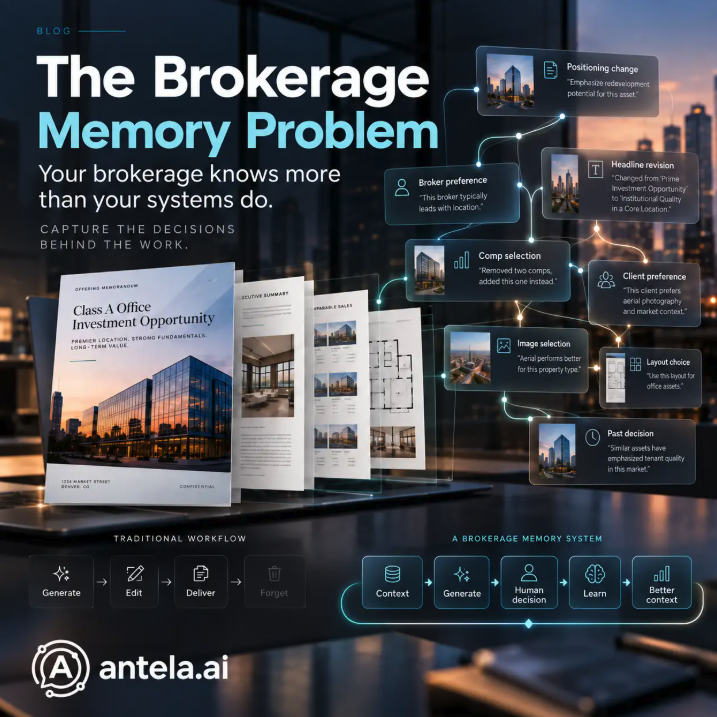
- A broker changes the positioning.
- A comp gets removed and another gets added.
- The hero image changes.
- A headline gets rewritten.
- A map is adjusted.
- The order of the presentation changes.
- The broker asks the team to emphasize something because they understand the owner, buyer, or market.
Individually, those can look like small edits.
Collectively, they represent something much more valuable: the operating judgment of the brokerage.
Today, most software helps execute those decisions.
Very little software remembers them.
Documents capture outcomes — not decisions
Templates are useful.
So are libraries of previous offering memorandums, brochures, proposals, and campaigns.
But a template tells you what the last deliverable looked like.
It usually cannot tell you why it looked that way.
- Why was that headline chosen?
- Why was one comparable considered more relevant than another?
- Why was access to transportation emphasized for one property while tenant quality led the story for another?
- Was that layout a firm standard, a broker preference, or something specific to the client?
The finished document preserves the outcome.
The reasoning that produced it is usually lost.
That distinction becomes increasingly important as firms introduce generative AI.
Give an AI system the previous OM and it can inspect the output.
Give it ten previous OMs and it may identify patterns.
But the documents alone still may not tell it whether those patterns were intentional, situational, outdated, or the result of a specific broker's judgment.
Output is not the same thing as institutional knowledge. Institutional knowledge includes the decisions behind the output.
Every workflow produces decision exhaust
Every time people work with software, they create a valuable byproduct that most organizations largely discard.
We call it decision exhaust.
It is the trail of human judgment produced during normal work:
- Revisions
- Selections
- Approvals
- Overrides
- Rejected recommendations
- Exceptions
- Preferences
- Corrections
Consider a broker reviewing an AI-generated marketing package.
The AI proposes five comps. The broker removes two and adds another.
That interaction contains information.
The broker changes the headline to emphasize redevelopment potential.
More information.
The marketing team replaces the hero image because they know a different presentation works better for that property type.
More information.
The broker changes the positioning because of something they know about the owner.
More information.
Traditional software treats these primarily as edits required to finish the deliverable.
A brokerage-memory system should treat them as signals about how the organization makes decisions.
But if those decisions are never captured in the first place, there is nothing to interpret later.
Once the workflow ends, the knowledge disappears with it.
You can regenerate the document. You cannot recreate judgment that was never recorded.
From generative AI to organizational learning
Most generative AI workflows today look something like this:
The AI generates something useful.
A human improves it.
The work gets completed.
Then the next workflow begins.
The problem is that some of the most valuable information was created after generation — when an experienced person decided what was right, wrong, or missing.
A different model becomes possible when those decisions are intentionally captured:
That changes the goal.
From: generate this deliverable.
To: understand how we make these decisions — and make that knowledge available the next time it is relevant.
Standalone AI is extraordinarily good at generation.
What it does not automatically provide is a persistent, governed memory of how a particular brokerage operates.
That requires capturing the decision in context:
- Who made it?
- Which property was involved?
- What asset class?
- Which client?
- Which market?
- What recommendation changed?
- Was it an individual preference or a firm standard?
- Should that knowledge apply next time?
Without that layer, faster generation can simply produce faster repetition.
With it, each workflow can improve the context available to the next one.
The compounding advantage
Imagine two brokerages using AI.
Both can generate an OM faster.
Both can draft property descriptions.
Both can summarize market information.
Both can create first-pass marketing content.
But one brokerage also retains what its people teach the system during the work.
After 10 listings, it knows more about how that brokerage operates.
After 100, it knows more still.
It has accumulated broker preferences, positioning patterns, approved language, client conventions, revision history, and examples of where human judgment overrode the original recommendation.
The advantage is not simply that the AI generates faster.
The organization's judgment starts to compound.
And importantly, this does not require removing humans from the process.
It does the opposite.
The human decisions are the valuable part. The objective is to preserve them.
Building brokerage memory
A senior broker may have developed judgment over hundreds of transactions and decades in the market.
Today, much of that expertise leaves little durable trail beyond the final documents and the people who worked alongside them.
Imagine if every transaction also strengthened the brokerage's institutional memory.
- New employees could start with more context.
- Marketing teams could spend less time reconstructing preferences.
- Experienced brokers could correct the system once instead of repeatedly making the same correction.
- Standards could become more consistent without forcing every person or property into the same template.
- And the organization could retain more of what it learns as people, markets, and teams change.
That is a very different value proposition from simply creating another document faster.
Templates preserve outputs.
Databases preserve facts.
Documents preserve deliverables.
Brokerage memory preserves why your people make the choices they make.
The most valuable AI system in a brokerage may eventually be the one that knows not only your properties, your documents, and your data — but how your people make decisions.
Ready to see what brokerage memory could look like in practice?
Antela is building an AI operating system for commercial real estate that connects the listing workflow, the decisions made inside it, and the knowledge a brokerage builds over time. Try Antela with one listing, or book a demo to walk through how your team works today.
Frequently asked questions
What is the brokerage memory problem?
Commercial real estate brokerages accumulate years of judgment: which comps matter, how an asset should be positioned, what a client cares about, and which language works for a property type. Most of that knowledge exists, but very little of it exists in a form the brokerage can systematically reuse.
What is decision exhaust?
Decision exhaust is the trail of human judgment produced during normal work: revisions, selections, approvals, overrides, rejected recommendations, exceptions, preferences, and corrections. Traditional software treats these as edits required to finish a deliverable. A brokerage-memory system treats them as signals about how the organization makes decisions.
Why aren't finished documents enough for AI to learn how a brokerage works?
A finished offering memorandum or brochure preserves the outcome. It usually cannot explain why a headline was chosen, why one comparable was more relevant than another, or whether a layout was a firm standard, a broker preference, or something specific to the client. Output is not the same thing as institutional knowledge.
Does capturing brokerage memory mean removing brokers from the process?
No. The human decisions are the valuable part. The objective is to preserve them in context—who made the decision, for which property, client, market, and asset class—so the next workflow starts with a better record of how that brokerage operates.
Related Reading
More in InsightsBrokerage
What Is a Commercial Real Estate Operating System?
A clear definition of a commercial real estate operating system—how it differs from CRM and marketing suites, and how brokerages evaluate one.
Brokerage
Brokerage Software vs CRE Operating System
How commercial real estate brokerage software differs from a CRE operating system—and how to choose the right evaluation lens.
Brokerage
From Point Solutions to AI-Native Operating Systems
Why CRE brokerages need a new software model — not just better features. Digitization isn't automation, and most AI features still leave brokers as human middleware.
Brokerage
What This Looks Like in Practice: How Antela Is Helping CRE Teams
The shift toward an AI-native brokerage isn't theoretical. Here's how CRE teams use Antela to win listings, bring properties to market faster, and scale without adding overhead.
Brokerage
How to Evaluate CRE Brokerage Software
A practical scorecard for evaluating commercial real estate brokerage software: workflows, brand controls, CRM linkage, pricing, and pilots.